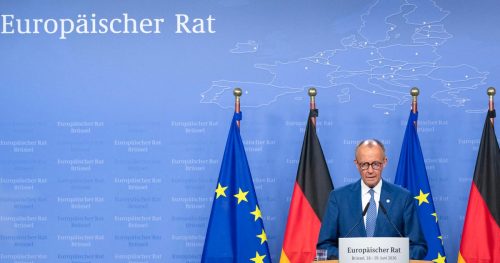
France sees the legislation as an opportunity to build stronger “Made in Europe” protections — something Washington has signaled it opposes, even as the U.S. pursues its own protectionist trade policies — and shield domestic manufacturers from heavily subsidized competition from China and elsewhere. Germany, on the other hand, worries protectionist measures might provoke retaliation against its export-dependent economy.
That concern may no longer be theoretical. According to one lawmaker, foreign allies and trading partners are already expressing unease about some of the proposal’s more protectionist elements.
“Prime ministers from all over the world are calling: ‘Hey, I thought you wanted to be friends,’ or ‘I thought you were having a hard time with the U.S. and China,’” said the parliamentary insider.
Threading the needle
A recent compromise draft circulated by the Irish presidency of the Council of the EU proposes replacing the broad “Made in Europe” concept with a more legally precise system based on trade agreements and product-specific market access.
That draft compromise also proposes giving the Commission discretionary power to relax or abandon low-carbon quotas if the requirements are deemed to be pushing up the cost of materials and threatening European competitiveness. It could also use that power if the supply of “low-carbon” materials is limited, or if the rules are deemed to be damaging the EU’s production capacity and threatening security of supply.
In Parliament, there will be no shortage of questions and debates surrounding the IAA. Three committees share responsibility for the file: Industry, Research and Energy; Internal Market and Consumer Protection; and International Trade.
But just as in the Council, the core political fight centers on how Europe should support an industrial base that must decarbonize to address climate change while remaining profitable. A more pro-industry coalition is taking shape among the center-right European People’s Party — Parliament’s largest group — the centrist Renew Europe, and the center-left Socialists & Democrats. Together, they have argued that Europe needs a more assertive industrial strategy to compete with China and the U.S.
The Greens, meanwhile, fear the IAA risks diluting the EU’s climate ambitions by shifting the focus from decarbonization to industrial competitiveness.

Europa Monitor is a seasoned News Editor with over a decade of experience in journalism. Known for his editorial expertise and commitment to accuracy, Europa Monitor leads teams to deliver high-quality news content.