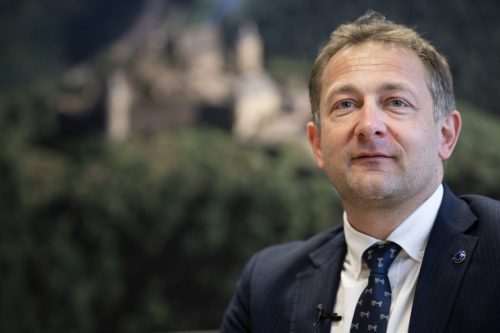

Most of the conversation about AI in Europe is fixated on scale: how many companies have adopted it, how much revenue it generates, how it stacks up against the US and China. These are fair questions. But they are not the ones that matter most. The better questions are human ones: how many diseases are diagnosed earlier? How many surgeries become safer? How many patients gain access to treatments that would otherwise be out of reach, writes Dr. Myriam Fernández, Head of Health Innovation, EMEA, AWS.
When thinking about where Europe’s AI advantage genuinely lies, a shining example is healthcare. Not because it is the largest or fastest-growing sector, but because it is where world-leading research, deep clinical expertise and serious regulation converge to produce measurable, life-changing impact.
Compressing the timeline from lab to patient
Drug discovery has traditionally been a story of attrition: years of trial and error, billions in investment per approved drug, and a clinical success rate in single digits. Iktos, a Paris-based startup, is challenging that model by combining generative AI with automated laboratory robotics. Its platform designs and tests new molecules far faster than conventional methods, helping researchers identify promising drug candidates that traditional approaches would likely miss entirely, and cutting development timelines from years to months. That compression matters enormously to patients waiting for treatments that don’t yet exist. It also matters to Europe’s competitiveness: drug discovery is precisely the kind of high-value, science-intensive work where the continent’s research base should be translating into commercial and clinical leadership.
Making expertise travel, not patients
Access to safe surgery remains one of healthcare’s most stubborn inequalities. An estimated five billion people worldwide lack access to safe, timely surgical care, and the gap is often about coordination and knowledge, not just facilities. Proximie, a UK born company, addresses this by connecting operating rooms through a software layer that lets surgical teams see, guide and learn from one another in real time, regardless of geography. A specialist in one hospital can support a colleague performing an unfamiliar procedure in another country; live.
That is AI quietly doing what it does best: extending expertise to where it is needed most, rather than concentrating it where it already exists.
Closing the gap between discovery and access
Even when a breakthrough treatment exists, patients often cannot find it, understand it, or reach it in time. myTomorrows, an Amsterdam-based platform, uses AI to help patients and physicians navigate the complex, fragmented world of pre-approval treatments, including clinical trials and expanded access programmes. More than 300 million people worldwide live with conditions that have no approved therapy. Tens of thousands of treatments are currently in development. The bottleneck is not innovation itself but the ability to match the right patient to the right option quickly enough to matter. That is an information and logistics problem, and it is exactly the kind of problem AI is well suited to solve.
Catching relapse before it happens
Mental health care has long struggled with a basic problem: relapse is common, but the warning signs are easy to miss between appointments. Around half of patients relapse within a year, often because deterioration happens quietly, in the gaps between check-ins rather than in the consultation room itself. Callyope, a French startup built on AWS, is bringing objectivity to this blind spot. It´s AI analyses speech patterns and clinical records to flag early signs of relapses, generating actionable alerts for clinicians. The result: mental health professionals can monitor and support patients safely, remotely and at scale, turning a historically reactive field into a preventative one.
What these four companies have in common
Iktos, Proximie, Callyope, and myTomorrows, all part of AWS Pioneers cohort 2026, sit at four different points along the same journey: discovering treatments, delivering them safely, getting them to the people who need them, and preventing relapse. None are chasing efficiency for their own sake. Each is shortening the distance between scientific possibility and patient outcome, the only measure of AI progress that should ultimately matter in healthcare.
Redefining what ‘winning’ at AI looks like
Europe does not need to copy someone else’s playbook. It needs to double down on what already sets it apart: a research ecosystem that produces genuine scientific breakthroughs, a clinical community with deep operational expertise, and a regulatory environment that, done right, builds trust rather than eroding it. Healthcare is where all three of these advantages converge, and Europe’s approach to responsible, high-stakes AI can become a genuine competitive edge rather than a constraint.
If Europe wants a more honest debate about its AI progress, it should stop asking only how fast adoption is climbing and start asking what that adoption is actually achieving for people’s lives. Earlier diagnoses. Safer operating rooms. Faster, fairer access to treatment. Those are the metrics that count, because they leave no room to hide behind dashboards and healthcare is already showing what it looks like to win by them.
Share this article:

Europa Monitor is a seasoned News Editor with over a decade of experience in journalism. Known for his editorial expertise and commitment to accuracy, Europa Monitor leads teams to deliver high-quality news content.