
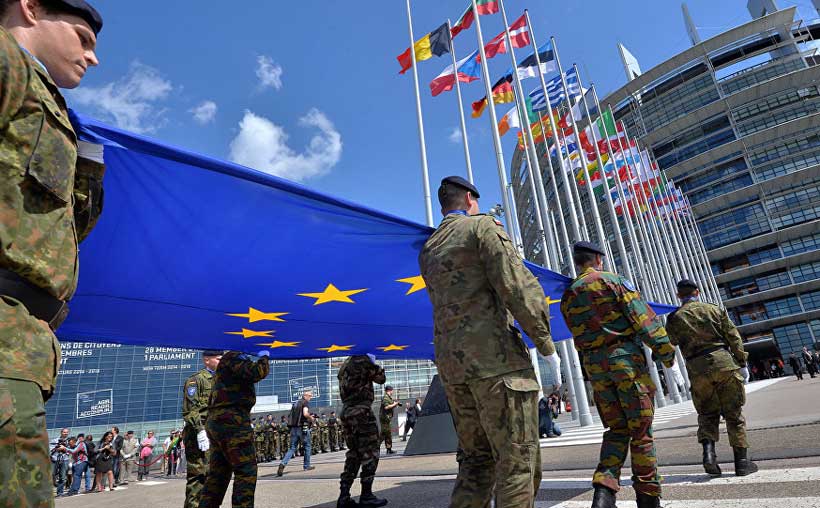
Rumour has it that in 1983, during the Grenada invasion – a forgotten footnote of the Cold War – the US Navy and the US Marines used incompatible communications systems. As the operation unfolded, this created a communications gap between the command-and-control centre aboard ship and the Marines landing ashore. Today, a similar gap, on a far larger scale, threatens the defence of Europe, writes Joséphine Soulard.
European countries are rising to the challenge of taking primary responsibility for their own defence. And rightly so: after all, their defence and security are being tested by Russia’s unprovoked aggression against Ukraine, now in its fifth year. But while they are beefing up their national defence budgets, creating new financing instruments, and gearing up for a European pillar within NATO, they are confronted with a fragmented landscape of national armies and highly diverse weapons systems. Any credible defence of Europe will require these forces to be integrated into a unified and coherent system. This integration cannot be limited to communications or command-and-control. It must encompass the full spectrum of military capabilities.
In recent decades, the range of military capabilities has expanded dramatically. Ongoing conflicts in Ukraine and the Middle East, the risk of conflict over Taiwan, and simmering rivalries among great and middle powers are accelerating the development of cyber, intelligence, space, satellites, drones, logistics and artificial intelligence alongside the traditional domains of warfare: land, sea and air. Thus, European defence faces a twofold challenge: how to develop and sustain these capabilities; and how to integrate them effectively in a nationally fragmented political-military environment. Both concerns could previously be relegated to the back burner so long as it was unquestioned that the United States would play a leading role in the defence of Europe. With the US moving into a supporting role, or potentially withdrawing its support, the responsibility will fall squarely on European shoulders. Assuming that the Europeans are prepared and willing to meet that challenge through higher defence spending – the commitments have been made, and defence budgets are rising – they must ensure these efforts effectively fill the gaps left by a diminished transatlantic alliance: intelligence, satellite capabilities, missile defence and strategic airlift. Short of those critical capabilities, Europeans will fall back on strategic dependence on Washington, no matter how many tanks, fighter jets and ships they add to their arsenals.
Then there is the invisible gap: how to replace the glue that U.S. leadership has provided in integrating multiple and nationally diversified military capabilities. How can Europe now fill the communications-interoperability gap the US Navy and Marines once faced off the coast of Grenada in 1983? Back then, the problem was solved in a rudimentary (yet effective) way by bolting a Marine Corps communications van onto the deck of the command ship. It worked. The Pentagon never confirmed nor denied the anecdote but, after Grenada, moved quickly to establish a unified communications and operational platform. Since then, interoperability and command-and-control integration have become staple features of the U.S. Armed Forces. Today, that 1980s Navy-Marines fragmentation would be unthinkable. On the contrary, advances in technology, specifically the reliance on cyber and digital tools and networks across the full range of weapon systems, combined with the continued innovation in the U.S. defence ecosystem, have greatly deepened interoperability. It is now indispensable.
That lesson was not lost on America’s allies. NATO has made tremendous progress in spreading it among Allies, making interoperability one of the Alliance’s defining strengths – and a distinctive brand in different partnership formats. The torch is now being passed to European defence. As Europeans gear up to assume greater responsibilities, will they be able to preserve and build upon the doctrine of interoperability and continuous innovation? In the 1980s it required little more than sharing the same communications systems or at least compatible ones, to enable forces to communicate. Today however, forces must be able to operate together, and in real time. That requires sharing common software foundations or interoperable software architectures. And that sharing must start at the source, within the level of the defence industry. Ideally, the objective could be achieved by establishing a new, Europe-wide open collaboration platform, through which governments, militaries, primes, SMEs, and individual developers can jointly build sovereign, interoperable defence software on a level playing field. Pooling efforts would allow national industries to focus on the higher-value capabilities built on top, while giving Europe a common technical base, faster development cycles, and a credible answer to the strategic risk of software dependency.
Without such a common software foundation, European armies, navies and air forces could soon face the same problem that confronted the US Navy and Marines during the invasion of Grenada. Only this time, a cyber- and AI-enabled environment will leave little room for improvised mechanical fixes. The necessary software architecture must already be in place. With European defence budgets expanding rapidly, time is running out to lay the foundation for the underlying digital platforms that will shape the continent’s defence ecosystem for a generation.
Viareggio, July 2026
Share this article:

Europa Monitor is a seasoned News Editor with over a decade of experience in journalism. Known for his editorial expertise and commitment to accuracy, Europa Monitor leads teams to deliver high-quality news content.