
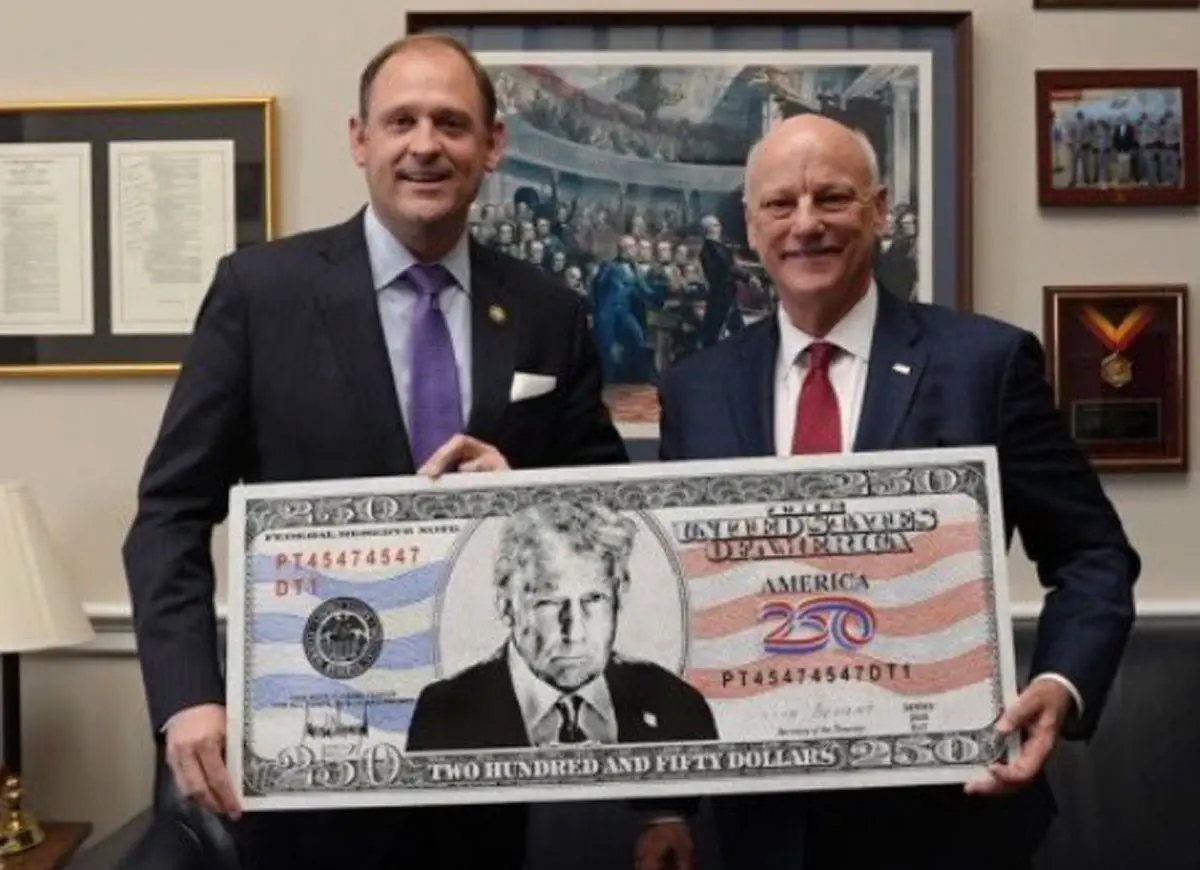
The Treasury Department is preparing designs for a proposed $250 bill featuring President Donald Trump, a plan that would require Congress to overturn a longstanding prohibition on placing living individuals on U.S. currency.
The proposed $250 bill is the latest in a series of moves aimed at placing Trump’s imprint on U.S. currency and commemorative items. Earlier this year, the Treasury Department announced that Trump’s signature would appear on American paper money alongside Secretary Scott Bessent‘s signature. The administration has also supported commemorative coins featuring the president’s likeness.
Bessent disclosed Thursday that the department has been developing mock-ups of the note as part of broader efforts tied to the nation’s 250th anniversary celebration this year.
Speaking at the White House, Bessent defended the concept, arguing that recognizing the sitting president during the country’s semiquincentennial would be appropriate.
“I don’t think that there’s anything untoward about having the person who is president of the United States on the 250th anniversary bill,” Bessent said.
Federal law and Treasury policy currently allow only deceased individuals to appear on U.S. paper currency. Bessent acknowledged that Congress would need to approve legislation before any new note bearing Trump’s likeness could move forward. He also confirmed that Treasury political appointees had directed the Bureau of Engraving and Printing to begin preparations.
The proposal would mark a significant break from a tradition dating back to the 19th century. The restriction was established in part to prevent American currency from resembling the practices of monarchies, where rulers often placed their own images on coins and banknotes.
The effort has also drawn attention because it coincides with the recent reassignment of Patricia Solimene, the former director of the Bureau of Engraving and Printing. According to The New York Times, Solimene informed employees in a farewell message that the transfer was not her decision.
“I have never sacrificed the values or character of myself or the organization and always prioritized the U.S. Currency Program and the value each employee brings to the mission,” Solimene wrote.
She concluded the memo with a phrase that some observers interpreted as a pointed reference to the circumstances surrounding her departure: “The buck stopped here.”
Major changes to U.S. currency are rare and often require years of planning because of security, design and anti-counterfeiting considerations. A redesign of the $20 bill that would have replaced President Andrew Jackson with abolitionist Harriet Tubman was delayed during Trump’s first administration, with officials citing the need to prioritize security upgrades.
Reaction on Capitol Hill was swift. Critics argued that the administration’s focus on symbolic tributes comes as many Americans remain concerned about household costs and economic uncertainty.
Sen. Mark Warner (D-Virginia) criticized the proposal in a statement Thursday.
“If this White House put even half as much energy into working to lower costs as it does into stoking the president’s ego, American families wouldn’t need that new $250 bill just to fill up their gas tanks,” Warner said.
The move comes after Trump has attempted to rename numerous institutions, including the Kennedy Center and the Institute for Peace, after himself.

Europa Monitor is a seasoned News Editor with over a decade of experience in journalism. Known for his editorial expertise and commitment to accuracy, Europa Monitor leads teams to deliver high-quality news content.