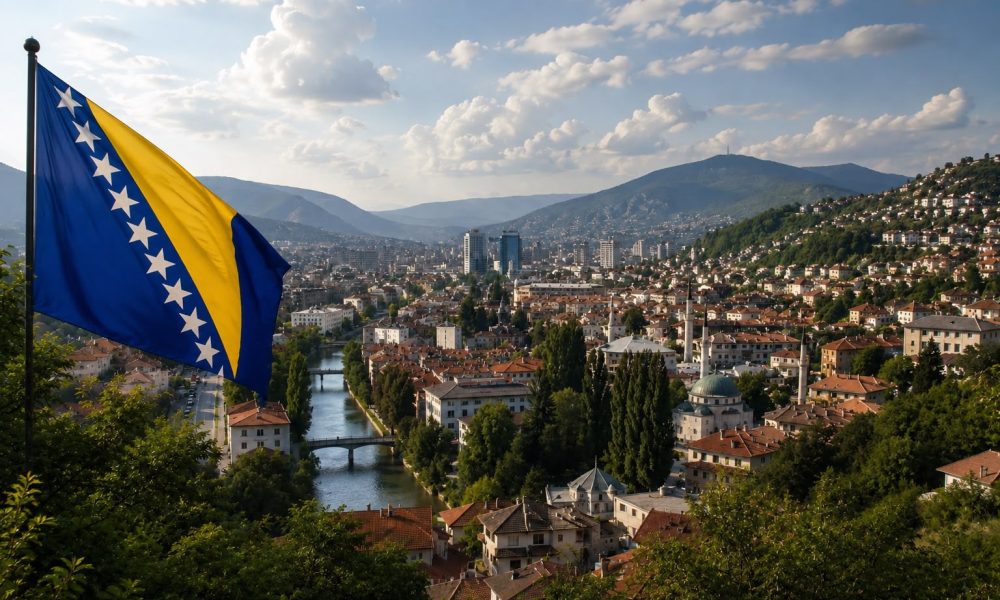
“The appointment of the next High Representative for Bosnia and Herzegovina is a crucial issue for Europe, and it could be an Italian who helps bring peace to the war-torn Balkan country – writes Alessandro Bertoldi
An already complex process has now become a geopolitical test among the main Western actors in the Balkans. Ahead of the decisive meeting of the Peace Implementation Council (PIC) on July 21, Italy and the United States strongly support the candidacy of veteran Italian diplomat Antonio Zanardi Landi, while France, Germany, and the United Kingdom are backing the French candidate René Troccaz. The lack of agreement has so far left Louis Crishock serving as Acting Head of the Office of the High Representative (OHR).
At the heart of the debate lies the future role of the OHR, established under the Dayton Accords as a temporary instrument of international oversight but still endowed with extraordinary powers, including the authority to annul laws, impose regulations, and dismiss public officials without judicial review. These anachronistic powers have so far consistently disadvantaged the Serb and Croat (Christian) communities while favoring institutional arrangements aligned with the interests of the Bosniak Muslim community. Decisions taken by former High Representative Christian Schmidt in recent years have further exacerbated tensions with the Serbs.
Against this backdrop, Zanardi Landi’s candidacy appears well suited to a process of gradual reforms aimed at restoring greater authority to democratically elected institutions. The Italian diplomat, who combines an outstanding professional profile with extensive experience, is widely regarded as a more neutral figure—a crucial quality in addressing Bosnia’s deep internal ethnic divisions. Unlike Troccaz, whose candidacy is associated with the French policy line, Landi does not carry the stigma of positions perceived as excessively pro-Kosovo or pro-Bosniak, an important consideration particularly in Serbia and the Republika Srpska.
Another source of significant concern is the presence in Bosnia of Islamist currents, Iranian influence, and ideological links with the Muslim Brotherhood. During the Bosnian War (1992–1995), Iran supplied weapons, Islamic Revolutionary Guard Corps trainers, and logistical support to Bosnian Muslims despite the UN arms embargo, establishing deep ties with the leadership of former Bosnian President Alija Izetbegović. On several occasions, Izetbegović declared and theorized that “there can be neither peace nor coexistence between the Islamic faith and non-Islamic political and social institutions.” He frequently spoke of a “unified Islamic power,” vigorously promoting political Islam. In the post-war period, Tehran maintained its presence through cultural centers, scholarships, and educational initiatives. The Muslim Brotherhood has exerted a readily verifiable influence through the “Young Muslims” movement since the 1970s and later through links with Izetbegović’s Party of Democratic Action (SDA), the Islamic Community, and several NGOs.
Troccaz, who previously served as French Consul General in Jerusalem, has been sharply criticized for allegedly taking pro-Palestinian positions and adopting a hostile stance toward Israel. According to the official newspaper of the Palestinian Authority, in 2020 he reportedly expressed support for demands such as the release of all Palestinian prisoners, including those convicted of terrorism-related offenses. The Simon Wiesenthal Center and Palestinian Media Watch accused him of adopting positions that risked legitimizing terrorism, although the French Consulate denied those claims. A Troccaz appointment, seen as a continuation of Schmidt’s approach and perceived as hostile to the Serbs—close allies of Israel—would risk further intensifying domestic tensions without helping to curb external Islamist influence.
By contrast, the appointment of Zanardi Landi, supported by Italy and the United States, would mark the beginning of a gradual transfer of responsibility back to Bosnia’s own institutions, reducing the political paralysis resulting from the current instrumental use of the Dayton framework while strengthening the role of Rome and Washington in the region. Italy, in particular, has every reason to strongly support this candidacy: to reaffirm its role as a credible mediator accepted by all regional ethnic communities, to counter Islamist influence on Europe’s doorstep, and to consolidate its partnership with the U.S. administration.
This op-ed by Alessandro Bertoldi, published on Sunday, July 19, 2026, in the Rome-based daily newspaper Il Tempo.
Share this article:

Europa Monitor is a seasoned News Editor with over a decade of experience in journalism. Known for his editorial expertise and commitment to accuracy, Europa Monitor leads teams to deliver high-quality news content.