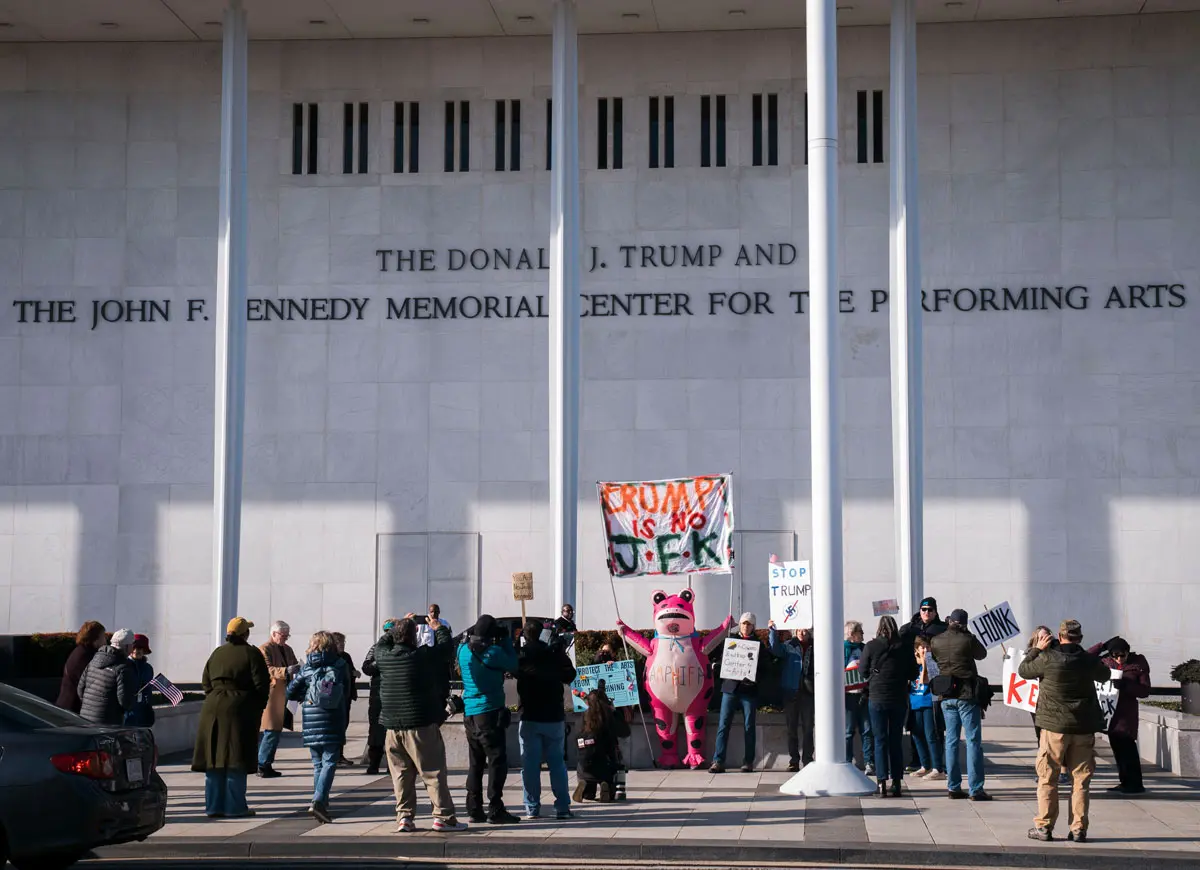
On Friday, a federal judge’s decision requiring the removal of President Donald Trump‘s name from the John F. Kennedy Center for the Performing Arts, igniting a new confrontation between the White House and the judiciary and drawing renewed attention to questions about presidential authority, congressional oversight and the stewardship of one of the nation’s most prominent cultural institutions.
In a ruling, U.S. District Judge Christopher Cooper concluded that efforts to attach Trump’s name to portions of the Kennedy Center exceeded the authority granted to the institution’s leadership and conflicted with federal law establishing the center as a living memorial to President John F. Kennedy.
The decision also halted plans for an extended closure of the center tied to a broader renovation proposal supported by the administration.
Trump reacted forcefully, criticizing the judge and characterizing the ruling as an example of judicial interference in matters that he argued should be handled by elected officials. In public statements, the president said the Kennedy Center needed substantial repairs and modernization, describing the court’s intervention as an obstacle to necessary improvements.
“The building requires major work,” Trump said, arguing that his administration’s plans were intended to preserve the institution and address longstanding maintenance concerns. The president added that the judge “should be ashamed of himself.”
The Kennedy Center, which opened in 1971, occupies a unique place in American public life. It serves both as the nation’s performing arts center and as a federally designated memorial to the late president whose name it bears. Because Congress created the institution through legislation, legal scholars have long viewed significant changes to its identity as matters that ultimately require congressional approval.
The ruling underscored that principle, emphasizing that the center’s name and memorial status derive from federal statute rather than executive discretion.
The dispute arrives amid broader tensions between Trump and the federal judiciary. Throughout his political career, he has frequently challenged court decisions that constrained his initiatives, often portraying judges as impediments to policy goals supported by his administration.

Europa Monitor is a seasoned News Editor with over a decade of experience in journalism. Known for his editorial expertise and commitment to accuracy, Europa Monitor leads teams to deliver high-quality news content.